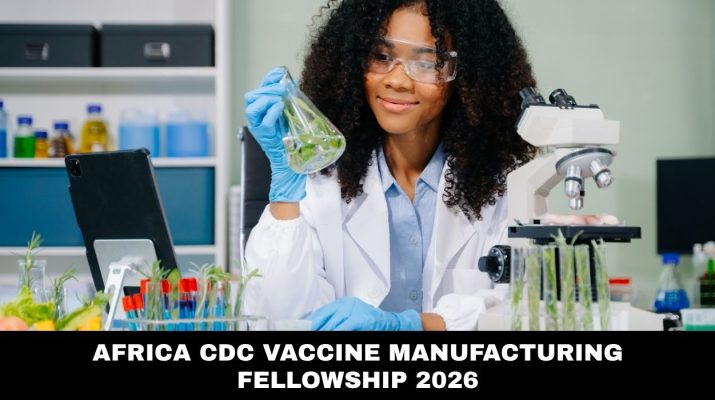
Applications are now open for the Africa CDC Industrial Fellowship Programme in Vaccine Manufacturing 2026, a fully funded opportunity designed to train the next generation of vaccine manufacturing professionals across Africa.
The programme is led by the Africa Centres for Disease Control and Prevention in collaboration with the African Vaccine Manufacturing Initiative. It will run from July 2026 to September 2027, placing selected fellows directly within active vaccine production facilities in Egypt, Senegal, and South Africa.
Only 14 candidates will be selected, making this a highly competitive and career-defining opportunity.
Why This Fellowship Matters
Africa is currently working toward a major goal under the Partnerships for African Vaccine Manufacturing (PAVM) framework: producing 60% of its vaccines locally by 2040.
To achieve this, the continent needs a significant expansion of its workforce—from a few thousand professionals today to over 12,000 skilled workers in vaccine development and production.
This fellowship addresses that gap by focusing on practical, industry-based training, rather than traditional academic learning. It equips participants with real-world skills needed to operate in modern pharmaceutical manufacturing environments.
What the Fellowship Covers
The programme is fully funded, with comprehensive support for all selected fellows. Benefits include:
- Return flight tickets to the host country
- Monthly stipend for living expenses
- Visa fee coverage and application support
- Full placement within a working vaccine manufacturing facility
Over the course of one year, fellows will gain hands-on experience in:
- Drug substance production
- Fill-and-finish manufacturing processes
- Quality assurance and control
- Regulatory frameworks and compliance (including cGMP standards)
This is a practical immersion programme, meaning fellows actively participate in real production environments rather than classroom-based training.
Eligibility Criteria
To apply, candidates must:
- Be citizens of an African Union member state
- Have graduated within the last three years
- Hold a Bachelor’s or Master’s degree in a relevant field such as:
- Pharmacy or Pharmaceutical Sciences
- Pharmaceutical Biotechnology
- Chemistry or Biochemistry
- Chemical Engineering
- Biomanufacturing or Vaccine Manufacturing
- Possess a valid passport
- Be proficient in English or French
- Be willing to relocate to Egypt, Senegal, or South Africa for the full duration
The programme strongly encourages applications from women and underrepresented groups, promoting inclusivity across the sector.
What Makes This Programme Unique?
Unlike many training opportunities that require travel outside Africa, this fellowship is designed to build capacity within the continent.
Key advantages include:
- Direct exposure to African manufacturing ecosystems
- Immediate, job-ready industrial skills
- Alignment with real workforce demands in the pharmaceutical sector
- Strong institutional backing from Africa CDC and its partners
Participants graduate with practical experience that significantly improves employability in the rapidly growing vaccine manufacturing industry.
Selection Process
Applications will be reviewed by a joint committee comprising representatives from Africa CDC and partner organisations. Due to the limited number of slots (14), only the most qualified candidates will be shortlisted and contacted.
Application Deadline
- Deadline: 30 April 2026
- Notification of selected candidates: By 15 May 2026
Early application is strongly recommended due to the competitive nature of the programme.
How to Apply
Submit your application through the official Africa CDC portal: https://tools.africacdc.org/africacdcrc/surveys/?s=8AENFDHCDCCRHTD4
Final Thoughts
The Africa CDC Vaccine Manufacturing Fellowship 2026 offers one of the most direct pathways into Africa’s emerging pharmaceutical manufacturing sector. With governments and institutions investing heavily in local vaccine production, demand for skilled professionals will continue to rise.
For graduates in engineering, life sciences, and related fields, this fellowship is more than training—it is an opportunity to become part of a strategic industry shaping the future of healthcare in Africa.